Showing posts with label Damselfly. Show all posts

Monday, May 30, 2011

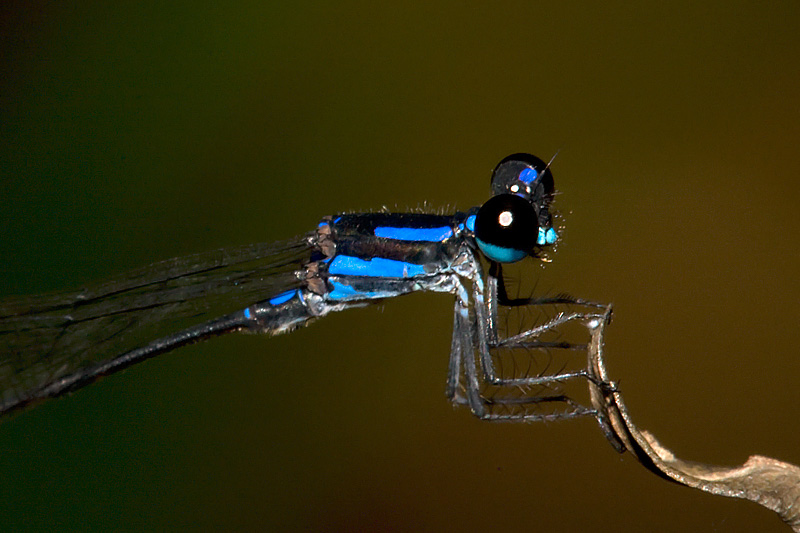
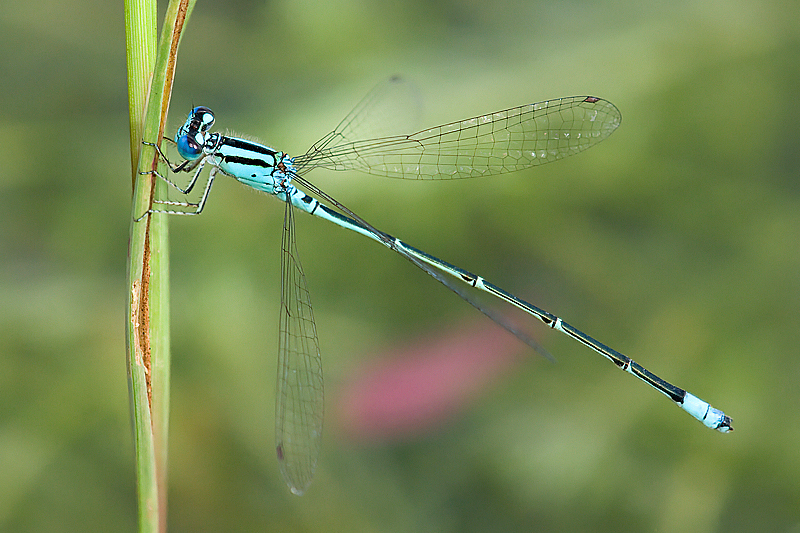
Damselfly (16b) - Amphicenis gracilis, Male

I am happy to have finally photographed a male, Amphicenis gracilis. Typically of this species, it perched near a small pool of smelly muddy water under very dim surrounding.  It was pretty tough shooting in such poor lighting condition especially this damselfly is highly sensitive to the use of flash.  As such, most of my images are captured without flash such as this one:

  
(Lornie Trail - 21 May 2011)

The following image is the only acceptable shot with flash:

(Shot with fill flash)

I will certainly revisit this place to get improvement shots as well as close-up.

See related posts:


Wednesday, October 06, 2010

Damselfly (31) - Libellago Stigmatizans

Family : Chlorocyphidae
Common Name : Orange-faced Gem
Status : Extinct in Singapore
Location : Panti Forest, Johor

Libellago Stigmatizans is one of the 4 Libellago species in Singapore.  While the other 3 species can still be found locally, L. Stigmatizans is classified as “probably extinct” in Singapore.  The male has turquoise-blue and black markings on its thorax with interesting bright orange coloration between its eyes.  The female has similar colours of the other 3 Libellago species which is greyish black in colour.

(Male - Panti Forest, 15 May 2010)

Two males were spotted in a stream about 2 to 3 metres wide, at Panti Forest (Johor, Malaysia) where the water was swift moving but quite muddy. They were flying non-stop and engaged in territorial fights. Occasionally, one would perch near the water surface but the next moment, you would see the 2nd one attacking it and they started fighting in mid-air again. Under such situation, shooting them with a tripod proved to be near impossible. So, I released my camera from the tripod, set to full flash mode and my target was to get both males fighting in the air in a single frame.


As the stream water was almost at knee-level high, I could not squat down as it would wet my backside. Standing would not be able to get close enough to the damselflies, so I had to blend down quite a little like an old man. It was tiring shooting in this position as I had to move where the damsels moved. I had to take a break every 5 minutes or so. This went on for the next half an hour and despite my hard work I failed to get the shots I wanted. I could only manage some flight shots of individual males as a consolation.


Initially, I tried using manual focus but my hands were not fast enough. Autofocus works better for me in this condition.  I am likely to visit Panti Forest in the near future and I hope to meet the female in my next visit there.


Thursday, September 30, 2010

Behaviours of Libellago Lineata

I was fortunate to witness some interesting behaviours of Libellago Lineata recently.  I saw a few pairs of males involving in territorial fights on separate occasions.  When they fight, the two males would confront  and face one another in mid air. They hover a few seconds and make forward movements but without contact.  Usually, one would flee the area after a minute or so but it would come back shortly to challenge the temporary winning male again until the utimate victor is declared!

(Two males involving in territorial fight - 29 Sep 2010)

The winning male has the right of the territory usually within a small area of not more than 3 metres.  I was told that female Lineata normally perch high up in trees and would come down to find a mate when they are ready to do so.  I have seen 3 mating pairs within 2 days and what was interesting is that unlike other damselflies where they usually mate for a long period (sometime in hours), Lineata only mates for about 20 to 30 seconds! Within such a short period of mating time, getting a good shot at it depends alot on luck.  I only managed to shoot about 20 shots from the 3 mating pairs add together, most of which are not of the best quality but I am happy to have finally got a good record mating shot of this species.  

(A mating pair in wheel formation - 29 Sep 2010)
  
After separation from mating, the female would perch on nearby floating log or large tree roots to lay eggs by submersing its adbominal tip into the water.

(A female dips the tip of its adbomen into water to lay eggs)

Based on my observation, the ovipositing process takes about 15 to 30 minutes.  During this period, the male will guard the ovipositing female from the disturbance by rival males by perching very nearby.  The female does not lay its eggs on a fixed spot, it would crawl usually forward as they ovipositing.  Sometimes they would fly away for a second or two but return to the perch.  During this egg laying process, there are good apportunities to shoot both the male and females in a single frame ie. side by side, back to back, facing each other, etc.

(A male guarding the ovipositing female)

(A male guarding the ovipositing female)

(A male guarding the ovipositing female)

Friday, September 24, 2010

Damselfly (30) - Libellago Lineata

Family : Chlorocyphidae
Common Name : Golden Gem
Status : Rare
Location : Lower Pierce Reservior

According to the The Singapore Dragonflies Book, this Golden Gem has only been recorded at Mandai forest stream.  The male has a similar thorax of Libellago Hyalina but it can be easier distinuished with its golden-yellow markings on the first 5-6 abdominal segments and black colour from segment 7-10.  The female is said to be bigger with greyish & dark marking on its thorax and abdomen.

(Juvenile Male - Lower Peirce Reservior, 23 Sep 2010)

The above damselfly was spotted perching on a dry twig near the edge of Lower Peirce Reservior.  For afar, based on at its colour and size, it looked like a female L. Hyalina to me.  But when I moved closer, I got the feeling that it could be a juvenile male L. Hyalina.  It was quite cooperative acutally but I could photograph only 3 shots due to my carelessness.  My tripod touched the twig accidentally when I moved closer causing it to shake violently.  It flew away and disappeared into nowhere!  I searched high and low for the next 20 mins or so but I could not locate it.

I seek Mr Tang's advice on its id and he told me that this could be a juvenile male, L. Lineata.  It doesn't quite look like what was described above as its colours have not fully developed yet.  A great find accordingly to him as it means that this species can be found elsewhere other than in Mandai forest.  He  asked me for the exact location which I obliged as he wanted to study this species further.  I shall visit this place again with the hope of shooting the adult species soon.

Afternote : I revisited this morning and was rewarded with this shot below.  The striking yellowish orange colour of this beautiful damselfly is particularly attractive to me.

(Adult Male - Lower Peirce Reservior, 27 Sep 2010)
 

Wednesday, September 15, 2010

Damselfly (28) - Agriocnemis Nana

Family : Coenagrionidae
Common Name : Dwarf Wisp
Status : Very rare
Location : Lornie Trail

This is the smallest damselfly in Singapore, a very rare species.  It is about 2 cm, slightly smaller than Agriocnemis Femina.  The thorax and abdomen of the male are blue in colour with black markings.  It looks like a smaller version of the male Pseudagrion Microcephalum.  The female has a greenish yellow with black marking thorax, more attractive than the male, in my opinion.

(Female - Lornie Trail, 15 Sep 2010)

I spotted this tiny female at Lornie Trail this morning.  After I took a single shot, a female dragonfly (Acisoma Panorpoides) suddenly came and preyed on it!  The dragonfly ate so fast that within a few minutes, my precious damselfly species was gone.  My friend found another female nearby but before we could capture it, it flew away.  As this species was very small in size, it was extremely difficult to re-locate it.  A real pity that I did not photograph this species well :-(  

(Eaten by a dragonfly - 15 Sep 2010)
Afternote : I revisited Lornie Trail on 20 Oct 2010 and I sighted one female around the same area.  I was happy to capture some improvement shots this time round.

(Lornie Trail - 20 Oct 2010)

Monday, September 06, 2010

Dragonfly (40) - Urothemis Signata

Family : Libellulidae
Common Name : Scarlet Basker
Status : Common
Location : Lornie Trail

This is another common dragonfly but my first sighting was only recently at Lornie Trail.  The eyes, thorax  and abdomen are all red in colour. From the dorsal view, there are 2 black marks near the abdomen tip.  I may have seen this species before and mistaken it as Crocothemis Servilia.  Both are all red in colour and you need to take a closer look to differentiate them.

(Male - Lornie Trail, 25 Aug 2010)

There were quite a no. of them flying near the reservior edge and a few of them appeared to enjoy perching under the hot sunlight. I was lucky to find one that perched comfortably under a shaded tree which made it easier for me to shoot. The female is said to be light yellow brown in colour which I hope to see one soon.

Friday, September 03, 2010

Damselfly (27) - Podasineura Interrupta

Family : Protoneuridae
Common Name : Interrupted Threadtail
Status : Uncommon forest species
Location : Endau-Rompin Natural Park, Malaysia

This is an uncommon damselfly that frequents dark forest streams.  In Singapore, it can only be found in Central Catchment and Bukit Timah Nature Reserves but I have not seen one here yet. 

(Male - Endau-Rompon National Park, 31 Aug 2010)

My first encounter with this species was at Panti forest, Malaysia but I didn't get any shots of it as I was busy shooting other species.  This was my 2nd sighting and it was spotted recently at a stream in Endau-Rompin National Park. 

(Side view - 31 Aug 2010)

The thorax of the male has nice bright blue bands on it as seen in the above image.  The upper part of the eyes is black and blue colour at the bottom half.

(Dorsal view - 31 Aug 2010)

One way to identify this species is to check the distinctive blue dorsal markings on it abdominal segments 9-10.  Also, there are two blue marks on the head near the eyes.  I hope to meet one in Singapore soon.

Wednesday, September 01, 2010

Damselfly (26) - Dysphaea Dimidiata

Family : Euphaeidae
Common Name : Black Velvetwing
Status : Extinct in Singapore
Location : Endau-Rompin National Park, Malaysia

According to the "Dragonflies of Singapore" book, this black with a slight purplish-coloured damselfly was already extinct in Singapore long ago.  This was photographed during my recent trip to Endau-Rompin National Park in Eastern Malaysia.  It was quite big is size and liked to perch on rocks in clear stream.  This male was quite skittish and I took quite sometimes to have finally got a decent shot of it.

(Male - Endau-Rompin National Park, Malaysia - 31 Aug 2010)

Monday, August 16, 2010

Damselfly (25) - Pseudagrion Australasiae

Family : Coenagrionidae
Common Name : Look-alike Sprite
Status : Uncommon
Location : Lornie Trail

After collected more than 50% of the damselfly species in Singapore, it is getting very difficult to add new species to my collection.  So, I was pleasantly surprised to spot this uncommon P. Australasiae at Lornie Trail this morning.  It was drizzing at that time but that did not stop me from photographing it.

(Female - Lornie Trail, 16 Aug 2010)

The female of this species should be rarer than the male.  The male looks very similar to P. Microcephalum where both are light blue in colour.  P. Australasiae is slighter bigger in size than P. Microcephalum.  Accordingly to Mr C.Y. Choong, the blue colour of P. Microcephalum is brighter than P. Australasiae but the ultimate confirmation on these two species is very much relied on the structure of their tail (anal appendages). Pseudagrion Microcephalum has longer anal appendages compared to P. Australasiae.  I have photographed both the male and female of P. Microcephalum but I am not sure whether I have shot the male of P. Australasiae as I did not know how to differentiate these 2 species previously.

(Female closeup - Lornie Trail, 16 Aug 2010)

On 25 Aug 2010, I have finally captured a decent shot of the skittish male.  Yes, it is indeed longer than P. Microcephalum and a strong flyer.  Not an easy species to photograph.  My next target is to shoot them mating!

(Male - Lornie Trail, 25 Aug 2010)

Saturday, August 07, 2010

A Book on Dragonflies of Singapore

A photographic guide to the Dragonflies of Singapore was officially launched on 2 August 2010. The book is published by the Raffles Museum of Biodiversity Research of the National University of Singapore, and is co-authored by Tang Hung Bun, Wang Luan Keng and Matti Hämäläinen. The following is a short paragraph about the book:

"In 1854 Alfred Russel Wallace collected 30 dragonfly species from Singapore. Since then a total of 124 species have been recorded within the territorial limits of the nation, including seven new records made just in the last two years. Dragonflies of Singapore covers all these species. Informative textual accounts of all species and large, full-colour photographs of almost every species enable the reader to identify almost any dragonfly encountered in the field. This book is an essential tool to enthusiasts, naturalists and general readers who wish to learn about dragonflies. At the same time, it captures quintessentially their sublime and ephemeral beauty."


I am glad to receive a complimentary copy on 19 Aug 2010 from the Authors as I have contributed one of my damselflies photos in the book.  A very well written book with nice, colourful pictures of all 124 dragonflies species.  With such a quality book, it is not expensive at S$22. 

If you wish to purchase a copy of the book, it is now available for order at this nature bookstore.

Saturday, May 15, 2010

Damselflies from Panti Forest

I joined my nature photography friends to Panti Forest today. There were 15 of us, 10 doing birding while the rest of us focused on macro shooting. Panti forest is more well-known for bird watching and photography, so it was really a pleasant surprise to me that there are so many species of damselflies, many of which cannot be found in Singapore.

(Heliocypha biforata, male)

(Libellago stigmatizans, Orange-faced Gem, male)

(Heliocypha biforata, female)

(Pseudagrion pruinosum, Grey Sprite, 赤斑蟌)

(Elattoneura analis)

(Rhinagrion macrocephalum)


Thursday, December 31, 2009

Damselfly (24) - Prodasineura Collaris

Family : Protoneuridae
Common Name : Collared Threadtails
Status : Uncommon
Location : Upper Peirce

There are 4 Proidasineura species in Singapore namely Collaris, Humeralis, Interrupta & Notostigma). The blue marking on the head and thorax of Collaris and Notostigma look similar to me and I have difficulty identifying them. My guess is that this is a Collaris based on the white or blue marking on the tip of its tail. Again, I would appreciate it if someone could confirm it.

(Upper Peirce - 31 Dec 2009)

(Side view close-up - Upper Peirce, 31 Dec 2009)

Wednesday, December 09, 2009

Damselfly (23) - Libellago Aurantiaca

Family : Chlorocyphidae
Common name : Fiery Gem
Status : Rare

Location : Upper Peirce, Endau Rompin National Park
 

Libellago is the most unique genus in Singapore with its wings longer than the body. They are rare, beautiful and require pristine habitat. Their behaviour is fascinating too. There are only three Libellago species in Singapore checklist, one of which (Libellago Stigamtizans) is already extinct here.

(Upper Peirce - 7 Dec 2009)

Although Libellago Aurantiaca is less rarer that Hyalina (see my previous post), it is my most wanted species to photograph. I pariticularly like its vibrant colour of red and yellow and I have been searching for more than a year. So you can imagine how happy I was when I finally saw one at Upper Pierce, the same place where I shot the Hyalina. They love to perch lowerly, just above the water making it difficult to get a good angle. I only managed a good record shot.  I have visited this place many times subsequently but this beautiful damselfly could not be found anymore.

Afternote : I finally got an improvement shot of this species but in Singapore.  This was taken at a swift flowing stream at Endau Rompin National Park.

(Endau Rompin National Park - 3 Oct 2010)

Damselfly (22) - Libellago Hyalina

Family : Chlorocyphidae
Common name : Clearwing Gem
Status : Critically Endangered
Location : Upper Peirce

Libellago Hyalina is a very rare damselfly. Upper Pierce is the only place where this species has been sited. It is therefore classified as critically endangered species. According to Mr Tang Hung Bun, an expert in Singapore Odonata, the common name of this species should be Clearwing Gem instead of Hyaline Jewel which was wrongly used by some people.

Libellago Hyalina is a confusing species because it has several colour forms for both male and female. It is not clear how many colour forms they actually have. The images below are some colour forms captured so far. There could be other colour forms that we are not aware of.

(Male, steel blue form - 3 Dec 2009)

(Male, glowing purple form - 5 Dec 2009)

(Female, grey form - 5 Dec 2009)

(Younger Female, orange form - 3 Dec 2009)

(Younger female, brown form - 7 Dec 2009)

Tuesday, October 27, 2009

Damselfly (21) - Mortonagrion Arthuri

Family : Coenagrionidae
Common Name : Arthur's Midget
Status : Rare
Location : Pulau Ubin

This damselfly species was first spotted on 11 Sep 2009 during a macro outing at Pulau Ubin.  There were about 4 males and a female perching near the edge of the mangrove swamp.  I only managed some record shots of them as I did not stay long due to too many mosquitoes attacking me.

(Male - Pulau Ubin, 26 Oct 2009)

When I sent the images to Mr Tang Bun Hung for idenitification, he said that he has only seen this species in mangrove areas in Singapore. As for male Mortonagrion arthuri, he has only seen a specimen soaked in alcohol, collected in traps by Dr Patrick Grootaert in Singapore earlier this year.  Although he was confident with his initial indentification, upon his request, I bought him to Pulau Ubin on 26 Oct 09 to further study this species.  His identification is correct.

(Female - Pulau Ubin, 26 Oct 2009)

(Female close-up - Pulau Ubin, 26 Oct 2009)

Wednesday, September 16, 2009

Damselfly (20) - Archibasis Melanocyana

Family : Coenagrionidae
Common name : Blue-nosed Sprite
Status : Rare
Location : Chestnut Ave

I went to Chestnut Ave to search for the unique Lestes Praemorsus Decipiens on 1 Aug 2009.  I did not find it but I saw this rare species instead.  I did not know that it was rare at that time and I did not make an effort to get some good shots.  Sadly, this place is destroyed and is under redevelopment for a condomium.

(Chestnut Ave, 1 Aug 2009)

(Chestnut Ave, 1 Aug 2009)

Wednesday, September 09, 2009

Damselfly (19) - Lestes praemorsus (隱紋絲蟌)

Family : Lestidae
Common name : Scalloped Spreadwing
Status : Uncommon
Location : Lornie Trail, Dairy Farm Nature Park, Chestnut Ave

Lestes Praemorsus is an uncommon species, first recorded in Singapore in 1997. It is known to be occured only in Macrichite Reservior. It is a medium-sized species which rests with its wings half-open. It has a unique hockey stick-shaped rather than straight obdomen.

(Chestnut Ave - 2 Nov 2009)

I went to Macrichite Reservior to search for this beautiful damselfly on 2 occasions but could not locate it. When Dairy Farm Nature Reserve Park was officially opened on 5 Sep 09, a picture of this mating damselfly was featured the next day in the Sunday Times. I went to Dairy Farm to try my luck and I was glad to have spotted a female perching just above the water at the Quarry. I could only take a record shot of it from a distance as we are not allowed to go down to the water. I hope it could perch in a better place during my next visit so that I could take an improvement shot.

(Lornie Trail - 14 Aug 2010)

I read that this species has since been found in several other places such as Pulau Tekong Reservior, Upper Seletar Reservior, etc. My friend, Eddy Lee, had recently photographed one at Chestnut Avenue.  He told me the exact location where he found this species and I am happy to get a slightly improvement shot of it.

I saw this species photographed by a new found friend, Federick Ho, at Lornie Trail.  He directed me on where to find this species.  I went there on 14 Aug 2010 and there were about 8 nos. perching lowly along the edges of Macrichite Reservior.  Got some shots but still plenty of rooms for improvement.

On 6 Sep 2010, I was happy to spot a mating pair where the female was laying its eggs into the water.
 

Thursday, August 13, 2009

Damselfly (18) - Prodasineura Humeralis

Family : Protoneuridae
Common Name : Orange-striped Threadtail
Status : Uncommon
Location : Chestnut Ave

Despite being a common species in Malaysia, this forest damselfly was recorded for the first time in Singapore at Chestnut area in Oct 2006. So I was glad to have spotted this uncommon  species at a stream along Chestnut Avenue Bicycle Trail on 4 Oct 2009. Not a difficult species to get close and it often returned to the same perch. But I observed that it preferred to perch very lowly just above the water surface of the fast moving stream making it tiring and difficult to get a good angle shot. The lighting was also not ideal as it usually chose a shaded perch. The colour of the male is generally dark brown from head to tail with some orange markings on its abdominal segment.

(Male - Chestnut Ave, 6 Oct 2009)

There were about 3 males in the steam when I revisited the place on 6 Oct 09. A female was spotted about 30 metres away from the stream. It has duller brown in colour with white marking on its abdomen. Initially, I thought it was a species that I had photographed before and as it was already quite late, I just took about 4 record shots and left. I regretted after I realised that it was a female of this species which reportedly is more uncommon than the males. I shall visit the place again to get an improvement shot.

(Female - Chestnut Ave, 6 Oct 2009)